Background :
This account is based on field interactions and conversations with members of the Banchhada community across different villages in Neemuch and Mandsaur districts of Madhya Pradesh. These interactions took place over the course of one year, beginning in July 2025, alongside the organization’s ongoing projects in these locations.
The Banchhada community is part of the broader category of Vimukt and Denotified Tribes (DNTs) – communities that were historically notified under laws such as the Criminal Tribes Act of 1871 and later “denotified” after Independence, but who continue to experience structural marginalisation in different forms (Renke Commission, 2008). In the present administrative framework, the community is classified as Scheduled Caste in Madhya Pradesh, as per the Constitution (Scheduled Castes) Order, 1950.
The community is primarily concentrated in western Madhya Pradesh, particularly in the districts of Neemuch, Mandsaur, and Ratlam, with an estimated population of approximately 23,000–30,000.
The community has been historically associated with hereditary, intergenerational, caste-based sex work as a livelihood practice. This practice is shaped by specific historical, economic, and social conditions, and cannot be understood as uniform across all members of the community. While it continues to be present in large parts of the community, experiences and practices vary across families and individuals.
The history of the Banchhada community, like that of many historically mobile communities in India, is preserved largely through oral narratives rather than a single written record. During fieldwork, it became clear that there is no one widely agreed-upon origin story. Many people themselves express uncertainty about their lineage or distant historical roots. Instead, community members often describe themselves broadly as a ghumakkad (nomadic) or connect their identity to larger groupings such as Bhantu or Bhatta.
Alongside this, several stories about the community’s past circulate within families and among local leaders. These narratives are not always uniformly known, but they offer insight into how the community understands its own history and social practices today. What emerges is not a single origin, but a set of parallel and sometimes overlapping accounts.
This document draws primarily from oral narratives shared voluntarily during field interactions, observations made by fieldworkers at Jan Shaurya, and available secondary references. The aim is to understand how the community sees itself, and how it makes sense of its history and present social arrangements. The terms used here reflect those found in oral narratives, historical records, and policy documents, and are used descriptively, not as value judgments.
Findings :
Oral Narrative 1: The King’s Demand and the Community’s Choice
One story, shared by a key informant, presently working as an AIIDS Health worker in Neemuch District, and some community elders, speaks of a time when a king (exact details unknown) demanded young women from the community for his court.
According to this narrative, the community faced a difficult moral choice: whether to send their daughters-in-law or their daughters. The community collectively decided to send their daughters while protecting daughters-in-law from this role.
Although this account cannot be historically verified, it resonates strongly with present-day social practices within the community, where a clear distinction in terms of attire, marriage symbols, availability for sex-work is maintained between daughters and daughters-in-law. Daughters-in-law are neither forced nor expected to enter the occupation and are required to follow norms of modesty and restraint. In contrast, daughters who enter sex work are marked by greater freedom in dress, movement, and self-presentation. These visual cues function as a shared language that regulates sexual access and draws firm boundaries, particularly in public spaces and place of work.
Oral Narrative 2: Association with Rajput Courts
Another oral narrative offered by two social workers from the community in Neemuch (M.P.) offers a different perspective on the community’s past. According to this account, the ancestors of the community were once associated with the courts of Rajput rulers in Rajasthan particularly Maharana Pratap.
Women were said to perform naach-gana (singing and dancing) in royal courts, while members of the community also worked as guptchar (informants or intelligence gatherers) for rulers.
References to roles such as intelligence gathering can also be found in certain ethnographic writings. For example, a study by Ghanshyam Gupta, titled Madhya Pradesh Ki Deh-Vyapaar Se Lanchhit Anusuchit Jatiyon Ka Kalyan, discusses the historical background of communities later associated with caste-based sex work. This study is cited in the government document Jabali Project for the Liberation and Rehabilitation of Caste-Based Prostitutes in Madhya Pradesh. While it does not directly link the community to Maharana Pratap, it mentions earlier forms of livelihood related to mobility and information gathering under different princely states.
Decline of Rajput Patronage
According to oral accounts, major changes in the livelihood options occurred after the decline of the Rajput armies and the arrival of the British when demand for entertainment and intelligence gathering declined. After this, the different groups spread out across the country started wandering and spreading out looking for alternate livelihoods and engaged in selling local forest produce and took up different gigs from time to time.
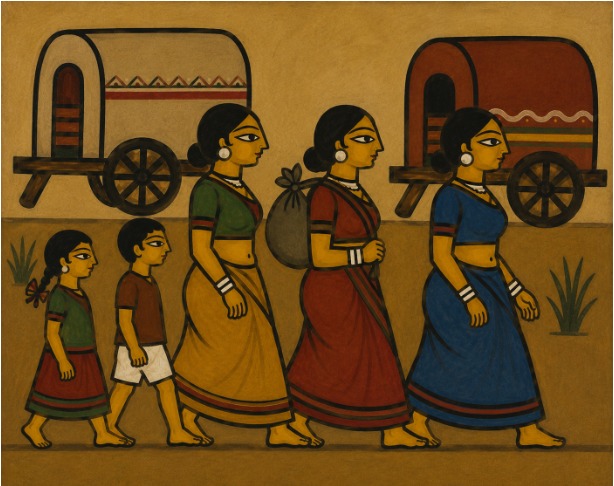
As traditional livelihoods declined, families began living in temporary encampments known as deras. These camps allowed them to move from place to place while seeking work.
Over time, some of these encampments gradually turned into permanent settlements, and places where the community once stayed temporarily eventually developed into villages.
According to informants, even today, villages in Madhya Pradesh inhabited by the Bancchada community are popularly referred to as deras.
Emergence of New Social Arrangements
Within these camps, the story describes how relations with local authorities sometimes shaped new social arrangements. According to informants, the landowner or village headman occasionally demanded sexual access to women from the community in exchange for providing land for camps. In response, the community is said to have developed internal rules governing who would be sent. Elder daughters were often designated for this role, while daughters-in-law were protected.
While the details of this story cannot be historically confirmed, it reflects a social distinction that continues to structure family roles within the community even today.
Alongside this, similar narratives emerge across accounts. Informants also recount a version in which, following the enforcement of the Criminal Tribes Act under British rule, men from the community were arrested, and colonial authorities allegedly demanded women in exchange for their release. In this telling, the practice of sending girls is framed as a coerced response to state power rather than local feudal arrangements.
Over time, such arrangements are said to have contributed to the stigmatization of these women within the community: they came to be viewed as impure, and marriage prospects diminished, eventually pushing many into sex work. Taken together, these narratives point to the practice of sending daughters as a recurring social pattern, also observable in contemporary living arrangements. However, the origins of the practice vary across accounts, most commonly situated in a period marked by the decline of Rajput polities and the consolidation of British rule in India.
Internal structures within the community also reinforce these patterns. According to informants, the Banchhada community is divided into twelve and a half gotras, many of which have historically been associated with occupations linked to sex work. These internal distinctions and rules help regulate relationships, marriage patterns, and social roles within the community even today.
State Narratives and the Jabali Scheme
Alongside these oral narratives, another reference to a short story about the offspring of a woman appears in government policy through the Jabali rehabilitation scheme introduced by the Madhya Pradesh government in 1992–93.
The name of the scheme symbolically draws from a story found in the Chandogya Upanishad about a boy named Satyakama.(4.4.1 – 9) When asked about his lineage, his mother, Jabali, tells him that she does not know his father, as she had him during her youth while engaged in service to many people. Despite this uncertainty regarding his parentage, Satyakama’s honesty leads to his acceptance by sage Gautam. The story is a classical example of how intellectual and spiritual merit (gunas) surpass the barriers of birth, caste, or family. However, this narrative does not commonly appear in community accounts and appears to represent an external framing introduced through state policy rather than an internally shared origin story.
Conclusion :
Taken together, these different stories suggest that the identity and history of the Banchhada community cannot be traced to a single origin narrative. Instead, it emerges through multiple memories, social adaptations, and survival strategies shaped across changing historical conditions. The strong social rules and distinctions observed today reflect this long process of negotiation and internal organization over time.
At the same time, it is important to know that the Banchhada community is understood as a subgroup within the larger Bhantu community, whose origins are relatively more traceable in comparison. While particular and definite origin stories of the Banchhadas themselves remain difficult to locate, there are clearer historical references to the Bhantu community as a whole. These accounts consistently describe a mobile population, likely originating from Rajasthan, often living outside the formal boundaries of caste society and engaged in itinerant forms of work, including entertainment, information gathering and small-scale occupations.
So rather than looking for a single, fixed point of origin for the Banchhada community, it becomes more useful to locate them within this broader historical pattern that defines the Bhantu community marked by mobility, marginality, and continuous adaptation to shifting structures of power and livelihood over time in Indian history.
References
National Commission for Denotified, Nomadic and Semi-Nomadic Tribes. (2008). Report of the National Commission for Denotified, Nomadic and Semi-Nomadic Tribes (Vol. 1). Ministry of Social Justice & Empowerment, Government of India.
Government of India. (1950). The Constitution (Scheduled Castes) Order, 1950.
Olivelle, P. (Trans.). (1998). The Early Upaniṣads: Annotated Text and Translation. Oxford University Press.
Jabali: Project for the liberation and rehabilitation of caste-based prostitutes in Madhya Pradesh. (n.d.). [Archived document]. Feminist Law Archives, Partners for Law in Development. https://feministlawarchives.pldindia.org/wp-content/uploads/Jabali-Project-for-the-Liberation-and-rehabilitation-of-Caste-based-prostitutes-in-Madhya-Pradesh.pdf
Acknowledgment
This article was edited by Mr. Akash Chauhan (Founder)
Inputs were provided by Mr. Shyamlal Malviya (District Coordinator) and Mr. Ramesh Chandrawat (Block Coordinator) at Jan Shaurya. They are members of the community and have over 15 years of experience in social work. They also facilitated field visits and community interactions that informed this article.
About the Author
Anushka Saraswat is District Coordinator at Jan Shaurya.
Have feedback or want to contribute?
We welcome any grievances, corrections, or additions that may help enrich this understanding.
Write to us at: info@janshaurya.com
Disclaimer
This account is intended solely for documentation and knowledge purposes, based on field observations and conversations, and remains partial and interpretive in nature. It does not claim to be exhaustive and is limited by the scope of field access, available narratives, and the absence of a single verifiable historical record. Narratives have been included in a generalized form to preserve anonymity and avoid identification of individuals. It is neither a definitive academic account nor does it seek to represent, fix, or replace the community’s own understanding of its history and identity. As this is an evolving initiative, the document may be updated over time based on further research and community inputs.